BLOCKBLAST.COM ↗
Small blocks. A whole system of experiments.
Hungry Studio describes Block AI, its player-behavior simulation platform, alongside automated testing and A/B experiments used to evaluate player experience.
AI that refines game balance and player experience, connects advertising decisions with performance feedback, and helps clients grow.
Player feedback informs experience improvements. Retention and value signals inform acquisition decisions. New market feedback flows back into the product, creating a continuous learning loop.
Place a block, reshape a difficulty curve, and reallocate an example budget. Explore how experience and growth decisions connect.
Choose a shape, then select a cell to place it. Complete a row or column to clear it. Ask the strategy algorithm for a suggested move.
Change player skill and starting difficulty. Compare a fixed curve with an adaptive one in this simplified model of balance experimentation.
Three example creatives have different assumed costs and conversion rates. Compare allocations under the same budget.
Assumptions: A/B/C cost per click $0.60/$0.90/$0.40; conversion rates 4%/7%/2%. These are not real campaign data.
Interactive demos use local strategy algorithms and illustrative models. No client data or ad accounts are connected; outputs are not performance guarantees.
From player experience to market growth, explore how the industry turns data into decisions. Three public examples. Three perspectives on what comes next.
BLOCKBLAST.COM ↗
Hungry Studio describes Block AI, its player-behavior simulation platform, alongside automated testing and A/B experiments used to evaluate player experience.
SAY.GAMES ↗SayGames places analytics, data-driven strategies, and developer partnerships at the heart of its publishing model, connecting product insight with execution.
Official website · captured 22 Oct 2026 ↗
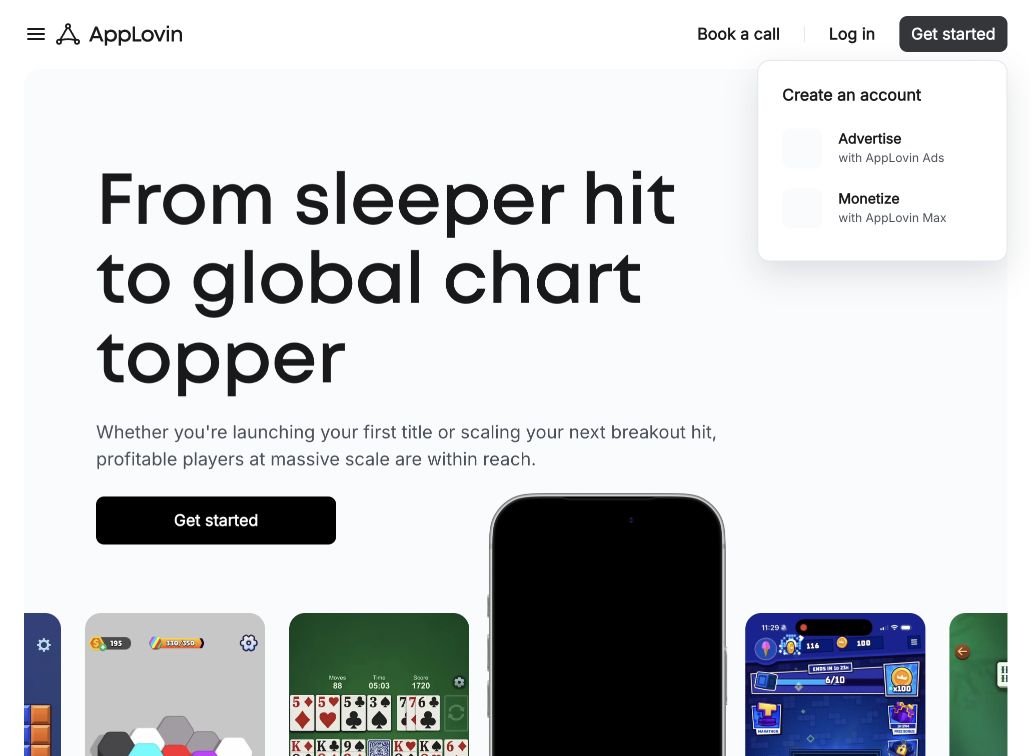
APPLOVIN.COM ↗AppLovin’s Axon AI predicts how likely users are to engage with advertising, supporting ad matching and performance optimization in the service of client growth.
AppLovin’s official Axon AI explanation ↗Public industry references for research and capability direction. These brands are not our clients or partners. Screenshots were captured from their official websites on 22 October 2026.

Founder · Entrepreneur & investor
From the beauty industry’s attention to subtle human experiences to gaming’s focus on every interaction, KIM SIKYUNG’s founding story follows one question: how can a deeper understanding of people create lasting value?
Born into a family with deep roots in South Korea’s beauty industry, her business background connects products, brands, and consumer experience. That heritage provides a starting point: care about how a product feels, and how it earns trust over time.
Her family’s investment in listed gaming company DoubleU Games generated substantial returns, building capital and an industry perspective for a new venture. Games reveal a distinctive possibility: every interaction and every experience can become a starting point for lasting value.
DOUBLEU GAMES · KRX / KOSPI 192080 ↗She brings that perspective to PLAYVIA: using AI to understand players, refine game balance and experience, and inform more effective advertising decisions. From product to growth, the ambition is to help game teams around the world build lasting businesses from creative ideas.
Start with player behavior, progression, and value signals to identify the product and growth questions worth testing.
Combine player simulation, game-balance experiments, and creative testing to evaluate whether changes deliver the intended experience and results.
Bring product and advertising feedback into the next iteration, building a growth approach that fits each client’s business.
The maker of Royal Match and Royal Kingdom publicly emphasizes technology, creativity, high-quality graphics, and immersive gameplay. Its product direction offers a useful perspective on lasting player experience.
View official source ↗Homa presents Homa Lab, analytics, an SDK, and creative-submission workflows alongside publishing expertise. It illustrates how tools and human judgment can support game development and validation.
View official source ↗Advertising brings players; the product shapes whether they stay. Considering experience, retention, and value together helps teams evaluate acquisition quality and product direction. Outcomes still need experimental validation.
Start with a clear experience goal: onboarding, challenge, achievement pacing, or progression. Define observable signals, then use simulation and controlled experiments to evaluate changes.
Discuss product stage, player audience, and current growth challenges. Choose a measurable starting point, run a bounded pilot, and use shared evaluation criteria to decide the next stage.
Agree on data scope, purpose, and access before a project starts, using only what the objective needs. Define experience goals, evaluation metrics, and stop conditions so decisions remain reviewable.

Tell us about your game, your players, and the growth challenge you want to solve. Let’s find the next move worth making.